


Game info
Multiplayer arena, Action
Learn original Agar.io gameplay, mouse and touch controls, splitting, mass ejection, virus hazards and practical cell-growth strategies.
Agar.io: grow a cell and keep room to escape
Agar.io is a multiplayer cell-eating game in which growth creates opportunities and new risks at the same time. Start as a tiny cell, eat scattered food and absorb smaller opponents while avoiding larger cells that can consume you. The interesting decision is rarely just where the most food lies: it is whether you can reach that food and leave the area safely.
Miniclip’s official Agar.io brings that simple rule into a competitive arena. Mouse movement, splitting and mass ejection create several ways to change a situation, but each action has consequences for the shape and size of your cell. Miniclip’s getting-started information explains the original game’s basic rules and controls. The sections below cover practical routes, attack decisions and ways to protect the growth you have already earned.
Gameplay Overview
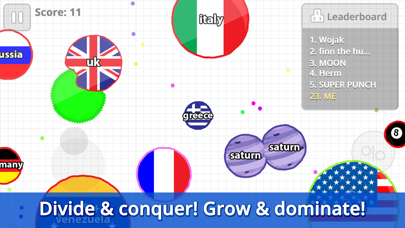
The arena turns a simple growth rule into a positioning problem. Food increases your size, smaller cells can become targets and larger cells force you to reconsider your route. Your size relative to nearby opponents matters more than an impressive-looking mass counter on its own. A cell that dominates one corner may still need to retreat from the next player approaching it.

Read movement as well as size. Notice which opponents are heading toward your food, which are already pursuing another cell and which are moving across your likely exit. A small detour can preserve the space needed to react. Chasing a tempting target directly through the middle of two larger players is a much harder problem than collecting a modest amount of food along an open edge. Growth becomes useful when you can protect it.
How to Play Your First Run
Choose an Agar.io game mode, enter a nickname and begin with a short movement check. Move the pointer gently around the arena and observe how your cell follows it. Before using a split key, learn how a wide turn feels and how close you can approach a neighbouring player without crowding your own escape.
For the first run, follow scattered food in a relatively open area. Do not cross the arena just because a dense patch is visible. Keep watching the largest cell near your route and change direction before it closes the available space. Your opening target is a controlled path through food, not an immediate place on the leaderboard. Once you have room, compare the risk of pursuing a smaller cell with the steady gain from collecting nearby pellets.
Agar.io Controls on Desktop and Mobile
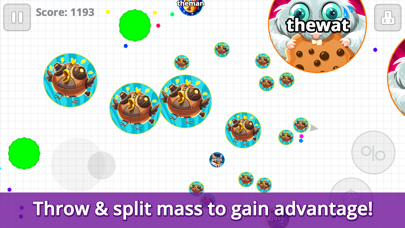
On desktop, the mouse pointer steers your Agar.io cell, Space splits and W ejects mass. Click the game area before using keyboard actions. Test a single split in open space and watch the resulting pieces before using the same action beside an opponent. Repeated splitting is a substantial change to your position, not a harmless way to move faster.
The official mobile game uses a touch joystick and dedicated shoot and split buttons. On either interface, point toward a clear route before triggering an action. If your aim changes while you are pressing a key or button repeatedly, the pieces or ejected mass may travel somewhere you did not intend. Smooth steering and a clear target make these simple controls much easier to use purposefully during an Agar.io chase.
Key Features to Understand
Relative size, splitting and arena space drive Agar.io’s main decisions. A larger cell can absorb suitable smaller cells, but splitting divides its mass into more exposed pieces. That makes an attack a trade between reach and protection: reaching a target is useful only if the pieces survive what happens afterwards.
Viruses add another size-sensitive hazard. A large cell that collides with one can be broken into smaller pieces, changing the local balance immediately. Smaller cells can use the space around viruses to make a direct pursuit more awkward for a larger opponent. Keep that geometry in mind while steering. A route beside a virus is not equivalent to an empty patch of arena, and a sudden change in the number of nearby pieces is a reason to reassess both threats and possible food.
Server Choices and Modes
Begin with a straightforward free-for-all activity when learning Agar.io. Each nearby cell is then evaluated through its size, direction and position, without adding a complicated team plan to the opening. Once movement and splitting are understandable, try a different original-game mode and identify which rules or objectives change.
The web game includes an Experimental mode, while official group play has its own process. Miniclip’s Agar.io Party Mode instructions explain how to arrange that activity. Agree on the room before starting instead of hoping that everyone independently joins the same arena. Practising together can make it easier to compare movement or split decisions, but the mode’s actual rules still determine which tactics are useful.
Pro Tips: Keep an Escape Route
Choose food that leaves you at least one usable direction afterward. For example, a line of pellets along open space may be safer than a richer patch between two large cells. The difference is not simply food density. It is how many threats can approach and how much steering room remains when you arrive.
Before crossing a narrow gap, look at both ends. If another cell can close the exit while you are halfway through, the route has a risk that may not be obvious from its entrance. Avoid sliding toward a boundary simply because a larger cell is behind you; a boundary can remove half your turning options. Make an early curved escape while the space still exists. In an arena game, moving away before a chase becomes urgent is often easier than correcting a trapped position.
Splitting with a Clear Purpose
A split should have a clear target, a plausible path and a plan for the pieces afterward. First check whether the intended target is still small enough relative to the resulting pieces. Then look beyond it for larger cells that could punish the move. Finally, ask where your newly divided body will be able to travel once the first burst is over.
Do not split merely because a target is close. A moving target can turn, and a larger neighbour can enter the space you expected to occupy. Missing a split attack is especially costly when it leaves smaller pieces spread across a busy area. Practise a deliberate split in a quieter part of the arena before using it during a chase. Success means controlling the resulting pieces and surviving the next decision, rather than only touching the first target.
Ejecting Mass without Losing the Plot
W ejects some of your Agar.io mass in the direction you are aiming. Watch the visible size change after a single press so that the cost is clear. Ejection has a different purpose from splitting: it sends material out without dividing the player into the same kind of moving attack pieces.
Repeated ejection during a chase can reduce the size advantage you were relying on. Material sent into a crowded area may also become useful to another player. Treat it like a trade: what are you giving away, what effect do you expect and what position remains afterward? If the action has no clear purpose, keep the mass and improve your route. When deliberately feeding a teammate or interacting with a virus under the current mode’s rules, check the direction carefully instead of pressing W automatically.
Read the Arena in Layers
Read the arena at three distances. Close to your cell, watch collision risk and the next steering adjustment. A little farther out, watch the cells that could intercept your intended path. Beyond that, notice crowded feeding areas and the general movement of larger opponents. This prevents a distant opportunity from consuming all your attention while a nearby threat becomes urgent.
The leaderboard is useful context, but it does not replace the local view. A player below the leader can still be large enough to absorb you. Conversely, a large cell on the far side of the map may not be your immediate problem. Keep the most attention on the threats that can reach your route soon. A smooth change of direction made early usually preserves more options than several sharp corrections after an opponent has already cut across you.
Advanced Practice: Review Decisions, Not Just Size
After a run ends, separate three possible mistakes: choosing a dangerous route, using an action at the wrong time or continuing a chase after the situation changed. Each calls for a different adjustment. A better split timing will not solve a route that led straight into a larger cell, and safer navigation will not explain an accidental mass-ejection key press.
Try a short practice set. Spend one run collecting food without splitting. In the next, allow one deliberate split only when the space beyond the target is clear. In another, watch for a moment when an opponent changes direction and stop your chase instead of automatically following. Compare what happened to your turning room. These exercises make Agar.io-style survival more understandable than judging progress only by the largest number reached.
Similar Games
Agar.io combines relative size, food collection and the risk of exposing smaller pieces during an attack. Those are useful mechanics to look for when exploring more growth and absorption games. A new arena can provide another way to practise moving through food without losing an escape route.
The related-game collection below offers more cell and growth activities. Choose a title according to the decision you want to practise, then learn how its movement and scoring work. Keep the useful skill specific: checking a larger neighbour before collecting, planning the position after an attack or leaving a crowded area before it closes. Returning to Agar.io with that decision in mind is more helpful than simply chasing the largest possible score in every game.
Browser games in this collection
- Agar.live (listed as AgarioCity.io) — A source listing linked to Agar.live, describing pellet growth, cell absorption and multiple server modes.
- Senpa.io — A cell-growth arena where size, movement, splitting and avoiding larger cells shape each encounter.
- Agario Game: Petri Dish — An agar-style arena with pellet feeding, cell division and virus-like obstacles described by the source.
- Eat Blobs Simulator — A three-dimensional blob-growth arena that absorbs smaller blobs while avoiding larger opponents, with solo and two-player options.
- Ball Eating Simulator — A ball-growth arena using size-based consumption of smaller balls and avoidance of larger rivals.
- Cellcraft.io — An agar-style cell arena with pointer steering, pellet feeding, splitting and mass ejection.
History, Updates and the Official Game
Agar.io’s cell arena became a recognisable example of online multiplayer play, and Miniclip also provides native mobile releases. The official Agar.io product page identifies the game and its supported download destinations. Use official information for account and purchase questions rather than trusting a similarly styled page to explain those records.
Miniclip’s support distinguishes the original web and mobile environments, including their player pools and some mode differences. That context matters when arranging a group session or comparing menus. For practical improvement, attach your observations to the activity you are playing: the same control can create a different tactical situation when team rules or experimental mechanics change the board. Keep the focus on the cells and space around the next decision rather than assuming one successful chase will work identically in every mode.
Start Small and Make Each Run Count
Begin your next Agar.io session by locating open food and a route away from the nearest large cell. Make the opening about steering and awareness. Add split attacks when you can explain where the resulting pieces should end up and why that space is likely to remain usable.
A productive run does not need to begin with a dramatic elimination. A steady opening gives you time to read neighbouring cells and decide when growth is worth exposure. When a run ends, keep one specific lesson: the gap was closing, the target stopped being isolated or the split left too little room. Use that observation in the next arena and let better decisions, rather than frantic input, carry the improvement.
Frequently asked questions
What is the goal of Agar.io?
Grow your cell by eating scattered food and smaller cells while avoiding larger opponents. Try to gain mass without losing the space needed to escape.
How do I move in the original Agar.io?
On desktop, move the mouse pointer to steer. The mobile game uses a touch joystick.
What do Space and W do in Agar.io?
Space splits on desktop and W ejects mass toward the pointer. The mobile game provides dedicated split and shoot controls.
Which mode should a beginner try?
A straightforward free-for-all activity is a useful place to learn movement, relative size and splitting before adding team or experimental rules.
Why do I get eaten after splitting?
The resulting pieces may be exposed to a larger nearby cell. Inspect the space beyond the target before attacking and protect the pieces after the initial movement.
How can I play the original Agar.io with friends?
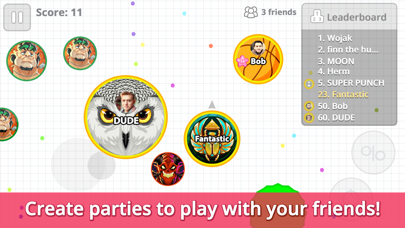
Use the original game’s Party Mode process described in Miniclip’s official support. Agree on the activity and room before beginning.
What is a safer way to collect food?
Choose food that leaves room to turn and at least one exit. A modest open patch can be better than a dense cluster surrounded by larger cells.
What should I practise before advanced Agar.io tactics?
Practise smooth movement, watching larger neighbours and leaving crowded areas early. Then add one deliberate split at a time so its result is easy to understand.

Good game? Tell us.0
Share a tip, celebrate a high score, or tell us what you think. Keep it friendly.